
Affiliate Tool Review · April 2026
SerpSling AI Review: After Testing the Real Tool, Here's What I Found
An honest breakdown of the AEO (Answer Engine Optimization) platform, keyword research, SERP analysis, and backlink features — tested in live niches, not taken from the sales page.
You've probably seen three or four SEO tools launch this month alone. They all promise the same thing — more rankings, less effort, results on autopilot. Most of them are variations of the same keyword scraper wearing a new logo. So when SerpSling AI came across my radar, I'll be honest: my expectations were low.
I didn't write this review from the sales page. I got review access, ran the tool on real niches — a competitive local service market, a dominant brand competitor, a full domain backlink profile — and I documented exactly what came back. The good, the limitations, and the parts that genuinely surprised me.
If you're trying to decide whether SerpSling AI belongs in your workflow, this review will give you a clear answer. Not a push in either direction — just the information you need to make the right call for your situation.
Quick Verdict — For Skimmers
What Works Well
- Full AEO audit — tells you exactly why a site isn't showing in AI search
- AI Booster WordPress plugin deploys schema markup automatically
- Separates Local Pack from organic SERPs (Search Engine Results Pages) — rare at this price
- Keyword data includes CPC, difficulty, and backlink averages
- Backlink analysis goes to IP and subnet level
- Spam score and authority rank built in
- Transparent credit refund if data can't be found
- Campaign and sub-user structure for agencies
- Intuitive UI — no learning curve
- Joshua Zamora's track record — tools stay supported long after launch
What to Watch
- Intent labeling isn't always accurate — verify manually
- Not a replacement for enterprise tools like Ahrefs
- Training content still being populated at launch
- Filtering options could be more granular
- AEO is still an emerging space — results vary by niche and timeline
What Is SerpSling AI?
SerpSling AI is a web-based AEO and SEO research platform from Joshua Zamora and the Zamurai Blogger team — the same group behind earlier versions of SerpSling. This AI iteration goes significantly further than its predecessors. Where older SerpSling versions focused on keyword research and rank tracking, this version is built around a fundamentally different problem: getting your content recommended inside AI search engines like ChatGPT, Google AI Overviews, Perplexity, and Bing CoPilot.
The platform operates across three core areas. First, it audits any website or business to identify exactly why it isn't showing up in AI search — missing schema (structured data markup that helps search and AI engines understand your page) signals (Experience, Expertise, Authoritativeness, and Trustworthiness — Google's framework for evaluating content quality), no structured data, poor entity recognition. Second, it fixes those issues for you — the AI Booster WordPress plugin injects optimised schema markup automatically with no coding required. Third, it generates AI-ready content in the formats AI search engines are trained to cite — FAQ blocks, location-specific service pages, "Why Choose Us" sections, and answer-first structured copy.
Alongside the AEO core, the platform retains a full SEO research suite: keyword research with CPC and difficulty data, Local Pack and organic SERP separation, domain and URL-level backlink analysis, site audits, rank tracking, and sub-user management. It's a more complete stack than most people realise from the launch marketing alone.
Why AEO matters right now — and why the timing is significant
Search behaviour has split in two and the gap is widening fast. Traditional SEO — ranking in Google's blue links — is still relevant, but AI search is growing at a pace that's difficult to overstate. ChatGPT alone handles over 1.5 billion visits per month. AI search queries grew over 400% last year. And the nature of AI search traffic is fundamentally different: when an AI engine recommends you, you're not one of ten links on a page competing for attention. You are the answer. That difference in conversion quality is significant — one SaaS brand cited in the sales case studies reported AI traffic converting at three times the rate of traditional SEO traffic.
Most businesses — including most of your clients' competitors — are invisible in AI search right now. According to data cited by the SerpSling team, 82% of businesses have done nothing to optimise for AI search engines. That gap is the opportunity. Early movers in any search paradigm earn authority that compounds over time and becomes progressively harder for late arrivals to close. We saw that in early Google SEO. We're seeing it again now with AI search — and the window is narrow.
SerpSling AI is positioned to help you capitalise on that window — either for your own properties or as a service you offer clients who don't yet know they have this problem.
A word on who built this — and why it matters
If you've been in the digital marketing space for any length of time, Joshua Zamora's name carries weight for a specific reason that has nothing to do with launch hype. I've been a customer of his for over five years. In that time, I've watched how he actually operates after the cart closes — and that's where most product creators quietly disappear.
Joshua doesn't. The same support team members — Dimitri and Yuri — have been with him throughout. Every tool I've purchased from him is still supported and still functional. When I've submitted feedback or made a suggestion, it didn't go into a void. Changes got made. That kind of responsiveness is genuinely rare in this space, and it matters to your buying decision more than any feature list.
"In five years as a customer, I've never submitted a support ticket that went unanswered — and feedback I've given has actually made it into product updates. That track record is part of the buying case here."
Buying a launch tool is partly a bet on the creator. With Joshua Zamora, that's a bet I've made multiple times with good results. That context is worth having before you decide.
How I Tested It
I didn't click around for five minutes and call it a review. I ran three distinct tests designed to answer real questions about the tool's output quality:
Test 1: Keyword research — seed keyword "Plumber in New York" — a local commercial niche with strong buyer intent signals and meaningful competition. I requested 200 keywords using the Related search mode.
Test 2: SERP analysis — I drilled into a competitive brand keyword ("roto-rooter brooklyn") to evaluate how the tool handles both local and organic results and what competitor intelligence it surfaces at the individual result level.
Test 3: Full domain backlink analysis on rotorooter.com — to test how deep the backlink engine actually goes.
These three tests together gave me a clear read on what SerpSling AI can and can't do. Let me walk you through each one.
Official demo — watch before reading
Keyword Research: What the Data Actually Looks Like
I requested 200 related keywords for "Plumber in New York." The system returned 108. Here's where something immediately stood out — the platform automatically refunded the credits for the keywords it couldn't find. That's not a small thing. Most tools simply deduct the full amount regardless of results. The fact that SerpSling handles it transparently is a real trust signal, especially if you're using this at volume.
The quality of what came back was solid. The tool surfaced keywords that any serious local SEO strategist would consider high-value targets:
A $57 cost-per-click tells you something immediately: businesses are competing aggressively for that traffic. High CPC is one of the clearest signals of commercial intent in a niche, and the fact that SerpSling surfaces it alongside difficulty and backlink averages means you can evaluate opportunity and competition in the same view — without jumping between tools.
Beyond that single example, the broader keyword set showed real strategic depth. It pulled borough-level geographic modifiers (Brooklyn, Manhattan, Queens), urgency modifiers like "24 hour plumber nyc" and "emergency plumber brooklyn," brand competitor variations (Roto-Rooter, Mr. Rooter), and "near me" permutations across multiple intent angles. That tells me the underlying engine is pulling from real Google search patterns rather than recycling a static keyword database.
Where the keyword data isn't perfect
The intent labeling needs some attention. "Emergency plumber near me" was classified as Navigational. In reality, that keyword is clearly transactional — someone searching that phrase is moments away from calling a plumber. The classification system appears to use rule-based logic rather than contextual understanding, so high-value commercial keywords occasionally get mislabeled.
This is worth knowing, but it doesn't break the tool. Any experienced SEO practitioner manually verifies intent before building a campaign anyway. What matters is that the volume and CPC data are there to make that judgment yourself.
The tool also surfaces salary-related keywords within a service niche (plumber salary, plumber average pay). This broadens the niche view beyond strict buyer intent — useful for content strategy and topical authority building, less useful for pure lead-gen targeting. Filter accordingly.
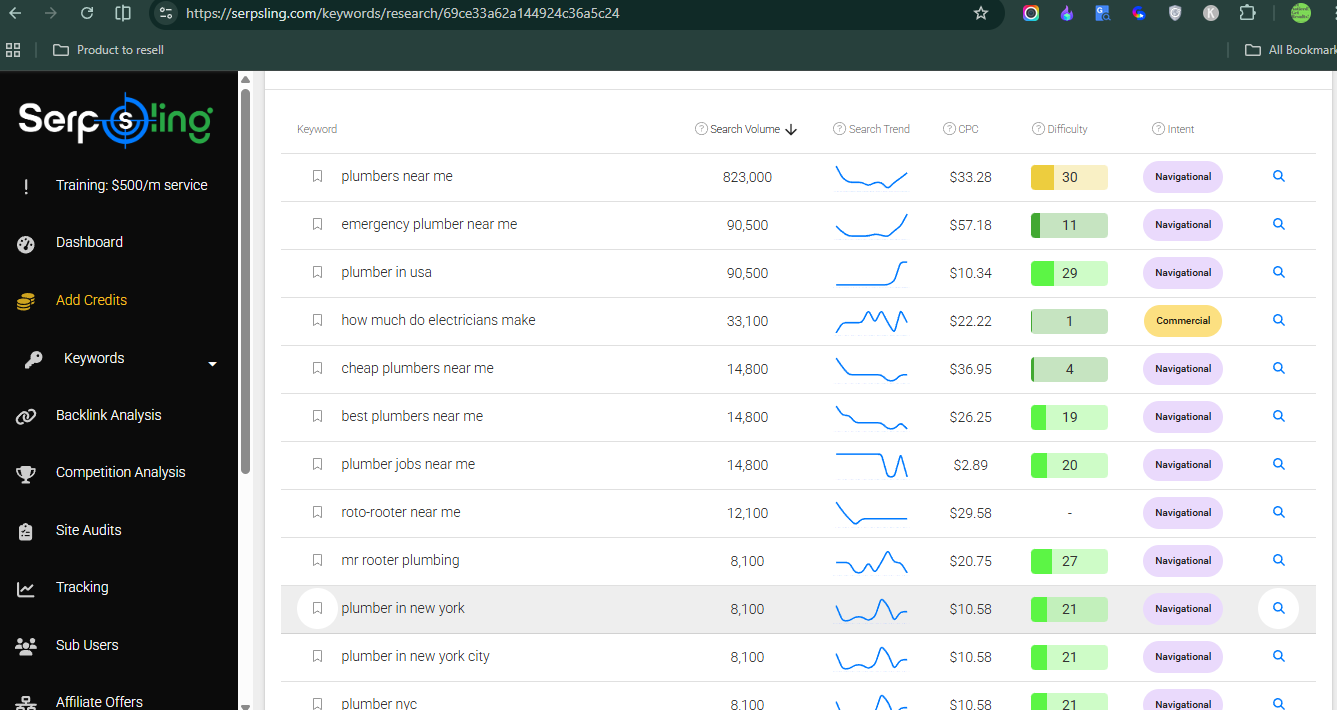
📸 [Insert: keyword research results table screenshot — plumber in New York]
SERP Analysis: The Feature That Actually Surprised Me
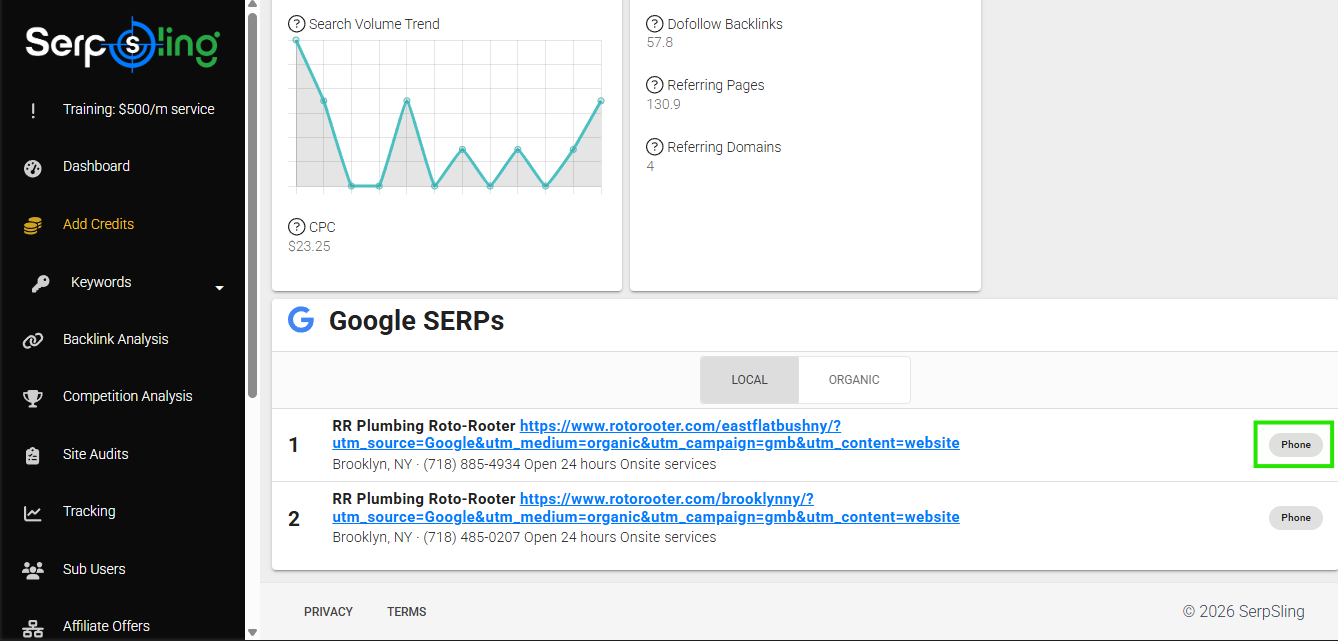
When I clicked into the keyword "roto-rooter brooklyn" from my results and opened its SERP view, I noticed something I didn't expect to find at this price point: a clean separation between Local Pack results and organic results, displayed in two distinct tabs.
Under the Local tab, the results included Google Business Profile listings with phone numbers revealed on hover, business hours, and onsite indicators. Under the Organic tab, I got the standard ranked URLs. This matters significantly for anyone running local campaigns. The Local Pack is often the most valuable SERP real estate for service businesses, and most budget tools don't distinguish between the two — they just show you a generic list of ten URLs.
The other thing worth noting here is what you can do once you're looking at a result. Under each ranking URL, SerpSling gives you four direct options:
Analyze URL Backlinks
Drill into the backlink profile of any specific ranking page.
Analyze Domain Backlinks
Pull full domain-level authority and link diversity data.
Analyze URL Competition
Evaluate how competitive the specific page is to outrank.
Analyze Domain Competition
Understand the overall domain-level competition landscape.
This turns the SERP view into a workflow, not just a data display. You research a keyword, see who's ranking, then move directly into competitive analysis on those specific domains — all within the same interface. That's a meaningful distinction from tools that show you rankings and leave you to figure out the rest yourself.
Backlink Analysis: Deeper Than Expected
I ran a full domain analysis on rotorooter.com. For context, this is one of the largest plumbing franchise brands in the US — a genuinely authoritative domain. Here's what SerpSling AI returned:
| Metric | Result | What it means |
|---|---|---|
| URL Rank | 31.5 (High) | Beatable with long-term focused effort |
| Spam Rank | 6 (Low) | Clean link profile, not artificially built |
| Total Backlinks | 9,817 | Strong overall link volume |
| Referring Domains | 1,583 | Broad distribution of unique linking sites |
| Referring Root Domains | 1,378 | High domain diversity |
| Referring IPs | 1,176 | Links from diverse hosting environments |
| Referring Subnets | 822 | Indicates natural, varied link acquisition |
The IP and subnet data is what catches my attention here. Most tools in this category stop at referring domains. IP and subnet diversity are indicators that a link profile was built organically across genuinely different web properties — as opposed to a network of sites sharing infrastructure. Including that in a launch tool's analysis output is more sophisticated than I expected.
The tool also provides a plain-language interpretation of its authority score. For example, a URL Rank between 25 and 40 is described as "high authority — possible to compete with but requiring a focused, long-term SEO campaign." That's genuinely useful framing for someone who isn't a seasoned analyst. It translates a number into a strategic decision.
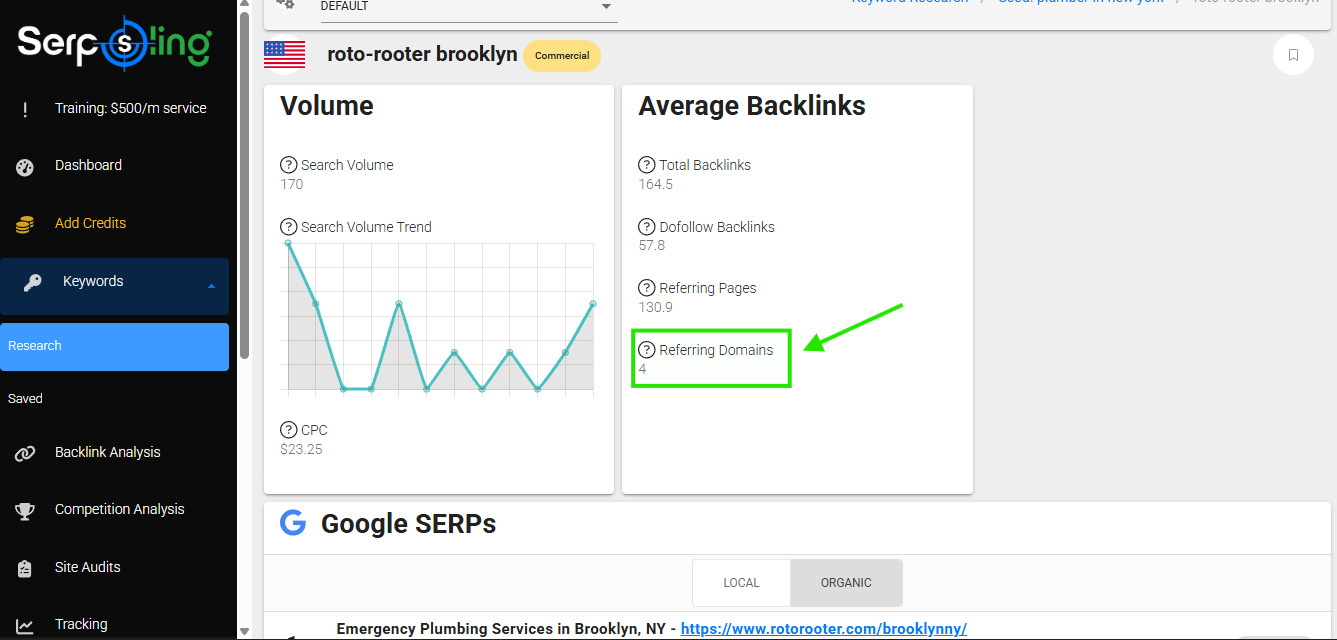
One strategic insight from this data: for branded local keywords like "roto-rooter brooklyn," the specific ranking pages showed only 4 referring domains — very low. That tells you brand authority is doing significant work in those rankings, not raw backlink volume. SerpSling surfaces that distinction, which changes how you'd approach a competitive strategy in that space.
The Full Feature Set
Here's the complete picture of what SerpSling AI includes — starting with the AEO tools that are new to this version, then the full SEO research suite underneath.
AI Visibility Audit Tool
Scans any website and tells you exactly why it isn't appearing in AI search engines — missing schema, weak E-E-A-T, no entity signals. You can charge clients $99–$299 just for this audit alone.
AI Booster WP Plugin
Automatically injects AI-optimised schema markup into any WordPress site with a few clicks. No coding required. This is the single most important technical step to being indexed by AI search engines.
Location-Specific AI Content
Generates city and service-specific pages written and structured for AI search — with proper schema added automatically. Powerful for local SEO and agency work.
FAQ + "Why Choose Us" Blocks
Adds instant trust and relevance by answering the buying questions AI engines are trained to surface. Directly improves recommendation likelihood in ChatGPT and Perplexity.
Smart Targeting Rules
Assigns specific schema to any post, page, or category automatically — so the right pages get recommended for the right queries in AI search.
Keyword Research
Four modes: Related, Suggested, Ideas, and Custom. Surfaces buyer intent keywords with CPC, difficulty, volume trends, and average backlink data for ranking pages.
SERP Analysis
Local Pack and organic results in separate tabs. Click-through competitor analysis on any result — visit, analyse backlinks, analyse competition, all from one view.
Backlink Analysis
URL and domain level. Includes authority rank, spam rank, total backlinks, referring IPs, and subnets. More depth than most tools at this price point.
Site Audits
On-page issue identification for your own domains or client sites.
Rank Tracking
Monitor keyword position movement over time across active campaigns.
Sub-User Management
Add and manage team members or clients under a single account. Built for agencies running multiple campaigns.
Affiliate Offer Discovery
Built-in tab for finding offers to promote — a useful addition for affiliate marketers building content sites.
The training section is being populated at launch — AEO tutorials, deep keyword analysis walkthroughs, and rank tracking guides are listed but not yet fully loaded at time of review. This is common in launch windows and will be filled in post-launch. The UI itself is intuitive enough that I navigated the core features without needing documentation.
Who Should Actually Buy This
This is the most important section of any review, because the wrong tool for the right reason is still a waste of money.
Buy it if you are...
- Running local SEO for clients and want to offer AEO as an additional service
- Building affiliate review sites and niche content properties
- A freelancer managing multiple client SEO campaigns
- An agency that needs sub-user access and campaign organisation
- Someone who wants to get ahead of AI search before competitors catch on
- A WordPress site owner who wants schema and AI optimisation handled automatically
- A marketer actively creating content and needing a research starting point
Skip it if you are...
- Already paying for Ahrefs or SEMrush and happy — this doesn't replace them
- Not on WordPress — the AI Booster plugin is WordPress-specific
- Expecting instant rankings without a content and strategy plan
- Looking for a set-and-forget traffic system
- Needing global keyword databases at enterprise depth
One thing worth stating plainly: for my own workflow, I'll be using SerpSling AI for keyword research on affiliate review pages, local SEO client campaigns, and to run AEO audits on my own sites to identify what's keeping me out of AI search results. The AEO audit alone identified gaps I didn't know existed. That practical application is what sold me beyond the feature list.
Pricing & Launch Window
SerpSling AI launches April 7, 2026. Pricing increases progressively through the launch window — earlier is genuinely cheaper here.
get5off (Apr 12–14) · get7off (Apr 14–15) · finalchance ($10 off, final hours until close). If you're reading this during launch week, apply the code that matches today's date at checkout — each one is valid for its window only.
A bundle option combining the front-end and upgrades at a discount is also available — check the sales page for current bundle pricing if you're considering multiple tiers.
View bundle pricing directly →Already have the front-end? Direct upgrade links
If you purchased SerpSling AI previously and want to add an upgrade, you can access each OTO directly below — your affiliate credit applies independently on each.
The Upgrade Stack: What Each OTO (One Time Offer) Actually Does
After you purchase the front-end, you'll be offered four optional upgrades — each presented once during the checkout process. Here's my honest read on each one — what it is, who it's genuinely useful for, and whether the logic holds up.
SerpSling AI Unlimited+
This removes every cap in the platform — unlimited audits, unlimited optimisations, unlimited AI-optimised content generation, unlimited deployments, and unlimited leads. Starts with a $1 trial then $47/month. Full commercial rights included, meaning you can use it for clients and charge what you like. Priority queue processing is also unlocked so your campaigns don't wait in line. For agencies or anyone running multiple sites, this is the upgrade that makes the tool scalable. If you're buying SerpSling AI to test it on one site, start with the front-end. If you're planning to build a service around it or run it across multiple client properties, this is worth locking in at launch pricing.
Get OTO 1 directly →Aigency Valet
This is a client-hunting tool specifically built around AI Search Optimization (AEO). It scans any city and niche to find local businesses that aren't showing up in ChatGPT, Google AI Overviews, Perplexity, or Bing CoPilot — and tells you exactly what's missing (schema, E-E-A-T signals, mobile issues, broken links, no social presence, and more). It also surfaces decision-maker contact details and includes done-for-you cold email templates with claimed 80%+ response rates. Genuinely interesting for agencies or freelancers who want to offer AEO services as a new recurring revenue stream. Less useful if you're purely building your own sites.
Get OTO 2 directly →DFY Authority
A 24/7 database that surfaces expired domains with existing backlinks, authority history, and — in some cases — existing citations inside AI search results. The core argument is that building on an aged domain with trust already baked in shortens the runway to ranking versus starting fresh. You get filtering by niche, authority, backlinks, and domain history. This one's worth considering if you're actively building affiliate or niche sites and understand how to evaluate domain authority. If you've never worked with expired domains before, there's a learning curve regardless of the tool.
Get OTO 3 directly →SyndLab
Automated posting of your content to X (Twitter), Pinterest, WordPress.com, and Blogger — platforms that AI search engines actively crawl and index. The idea is that AI engines don't just assess your website in isolation; they look at your broader web footprint. SyndLab builds those off-site citation signals on autopilot across up to 20 separate projects. The recurring fee is waived for launch customers — one-time payment only. If you're serious about AEO and want your content appearing across multiple indexed platforms without manual effort, this closes a gap that most people leave wide open. For someone just getting started, it may be ahead of where they are.
Get OTO 4 directly →What stands out about this upgrade stack is that it tells a coherent story: the front-end gives you research. OTO 1 keeps credits flowing. OTO 2 finds clients who need AEO services. OTO 3 gives you a head start on domain authority. OTO 4 builds your off-site citation footprint. Each upgrade makes more sense if you have the one before it — which is either smart product design or a well-structured funnel, depending on your perspective. Evaluate each on its own merit relative to your actual workflow.
SerpSling AI vs Ahrefs and SEMrush — and Why the Comparison Misses the Point
Almost every review of a launch SEO tool gets asked this question, so let's address it directly and then move past it: SerpSling AI is not a head-to-head competitor to Ahrefs or SEMrush, and it isn't trying to be.
Enterprise tools give you global keyword databases, years of historical data, content gap analysis, and API access at $100–$200+ per month. They're built for large teams running SEO across hundreds of domains with dedicated analysts. If that's your situation, you already have those tools and you're not reading this review.
What SerpSling AI offers that those tools don't — and this is where the comparison breaks down entirely — is AEO. Ahrefs and SEMrush are built around traditional search engine optimisation. Neither of them audits your AI search visibility, tells you why ChatGPT isn't citing you, deploys schema markup automatically, or generates FAQ and entity content structured for AI recommendation engines. That's a different problem requiring a different tool, and right now SerpSling AI is one of the few products in this space that addresses it at an accessible price point.
The honest framing: if you have Ahrefs for traditional SEO research and you're happy with it, keep it. Add SerpSling AI for the AEO layer it doesn't cover. If you've been working without proper SEO tools because the cost was prohibitive, SerpSling AI handles both the research and the AEO work in one dashboard at a fraction of enterprise pricing.
What real-world AEO results look like
The sales page includes case study data worth noting because it illustrates what's actually possible when AEO is implemented properly. A gaming accessories brand went from invisible in AI search to dominant across ChatGPT, Gemini, and Perplexity in under ten months — with a 27x increase in conversions from AI platforms. A remote staffing company went from zero AI visibility to top five in their entire industry in 30 days with a single optimised blog post. A local spa in South Delhi increased bookings by 41% in 90 days with no paid advertising — purely from voice search and AI recommendation optimisation.
These results are from companies that invested in AEO early, before their competitors understood what it was. That early-mover window is exactly where the market sits right now for most niches. SerpSling AI is the tool designed to help you act on it.
Final Verdict
Solid value for the right user — the AEO layer makes this more relevant than the price suggests
Loses points for intent labeling accuracy and training content gaps at launch. Earns them back on backlink depth, SERP separation, AEO auditing, schema automation, and five years of proven creator support.
Here's what I walked away thinking: this tool was built by people who actually use SEO tools, not just people who sell them. The credit refund logic, the Local Pack separation, the backlink depth that goes to IP and subnet level — these aren't features you add by copying a competitor's marketing page. They come from understanding what a working marketer actually needs to see. And the AEO layer on top of that is genuinely timely — not a manufactured angle, but a real response to a real shift in how people are finding information online.
The imperfections are real. Intent labeling occasionally misfires. The training library is still being built out at launch. Filtering could be more granular. But none of those things break the core workflow, and they're exactly the kind of things Joshua Zamora's team has historically refined based on customer feedback — which, from five years of experience, they actually act on.
Search has split into two battlegrounds. Traditional SEO is still important. AI search is growing faster than anything that's come before it, and 82% of businesses haven't touched it yet. The decision really comes down to one question: do you want to be in the group that moved early, or the group that catches up later at a higher cost and with more competition already established?
If you're actively building content, running client campaigns, or operating any kind of digital marketing business — this is a tool worth evaluating seriously during launch pricing. The gap between early bird and post-launch pricing is real, and it only moves in one direction.
If it fits your workflow, now is the time to move.
Early bird pricing starts at $34.95 — the lowest this will ever be. After launch closes, it goes to $97 permanently. Take a look at the demo, run through the features, and decide based on your actual situation.
See If SerpSling AI Fits Your Workflow →Affiliate link — I earn a commission if you purchase, at no extra cost to you. This review is based on my own hands-on testing of the review access account.
Frequently Asked Questions
Is SerpSling AI beginner friendly?
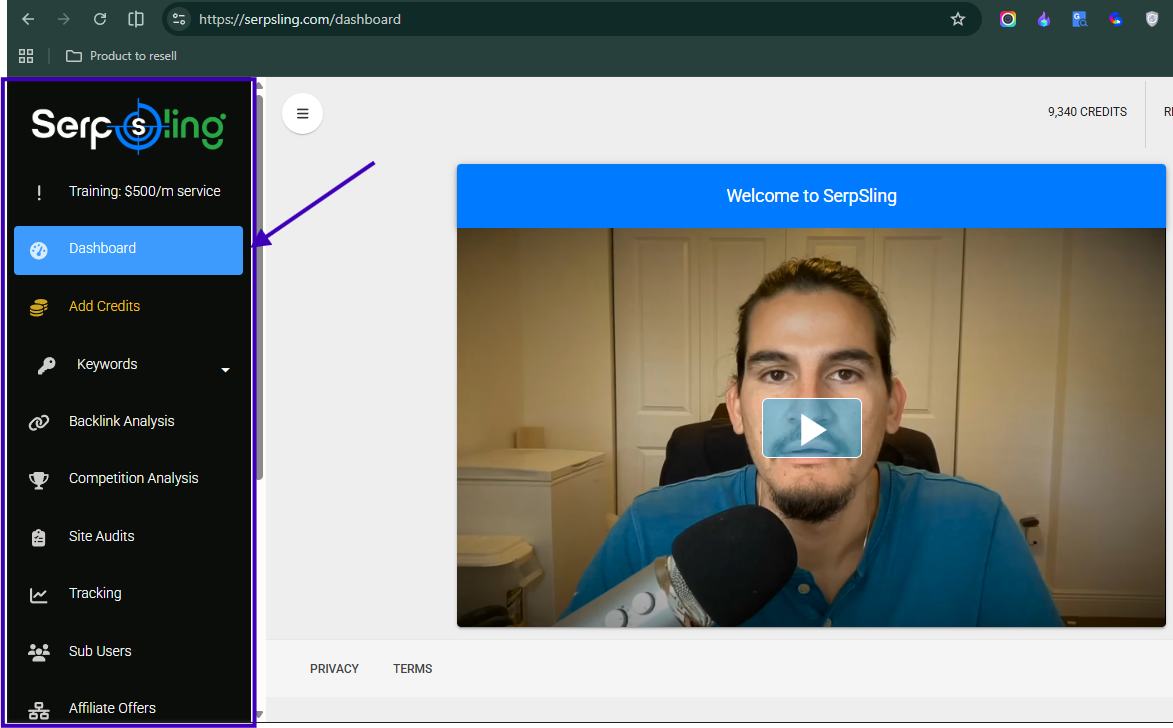
Yes. The interface is clean and intuitive — I navigated the keyword research, SERP analysis, and backlink tools without needing any training documentation. The UI uses a clear left-sidebar structure with logical flow between sections.
Does SerpSling AI include backlink analysis?
Yes, and it goes deeper than you'd typically expect at this price. You get URL rank, spam score, total backlinks, referring domains, referring IPs, and referring subnets — all within the same dashboard.
Does it show Local Pack results separately from organic?
Yes. This is one of its stronger features. Local Pack (Google Business Profile) results are displayed in a dedicated tab, separate from organic results, with phone numbers and business hours visible on hover.
What happens if it can't find enough keywords for my request?
The system automatically refunds unused credits proportionally. If you request 200 keywords and it returns 108, you're only charged for what was actually delivered. I confirmed this in my own test.
Is SerpSling AI cloud-based?
Yes. It runs entirely in the browser with no software to install. You can access it from any device.
Can agencies add sub-users?
Yes. Sub-user management is built into the platform, making it practical for agencies running campaigns for multiple clients or managing team members under one account.
How does SerpSling AI compare to Ahrefs or SEMrush?
It isn't a direct replacement. Enterprise tools offer broader data depth, historical tracking, and global databases at a higher monthly cost. SerpSling AI is a one-time purchase that covers the core research workflow — keyword discovery, SERP analysis, backlinks — at a fraction of the price. For agencies and affiliate marketers who don't need enterprise depth, it fills the gap effectively.
Does SerpSling AI work for non-WordPress sites?
The AI Visibility Audit, keyword research, SERP analysis, and backlink tools work for any site. However, the AI Booster plugin — which automatically injects schema markup for AI search optimisation — is a WordPress plugin. If your site isn't on WordPress, you can still use the audit findings to manually implement changes, but you won't get the one-click schema deployment that WordPress users get.
How quickly can you see results from AEO optimisation?
Results vary by niche, competition, and how thoroughly AEO is implemented. The case studies cited on the sales page show results ranging from 30 days (a staffing company reaching top 5 AI visibility in their industry) to 10 months (a major gaming brand achieving dominant AI search presence). For local businesses with less competition and a clear geographic focus, the timeline tends to be shorter. AEO, like traditional SEO, rewards consistency and proper implementation over shortcuts.
Who is Joshua Zamora and is he a credible creator?
Joshua Zamora is the founder of Zamurai Blogger and has been creating and supporting digital marketing tools for well over a decade. He has a strong reputation in the JVZoo space specifically because his products remain supported long after launch — not a common trait. From personal experience as a customer for over five years, his support team is responsive, issues get resolved, and feedback genuinely leads to product improvements. That track record is part of the buying case here.
Is this a one-time payment or subscription?
The front-end purchase during the launch window is a one-time payment. OTO 1 introduces an optional monthly subscription for ongoing credits at a locked-in discounted rate, but that's entirely optional. Check the current sales page for the most up-to-date pricing structure.
Which OTO is worth it for someone just starting out?
If you're new to the tool, start with the front-end and evaluate how quickly you use through credits. If you find yourself running regular keyword research or tracking multiple campaigns, OTO 1 (the monthly credit subscription) becomes the most practical upgrade since it locks in a discounted rate before prices increase inside the members area. The other OTOs — the AEO lead finder, expired domain engine, and content syndication tool — are more valuable once you have a clear strategy and client pipeline in place.
What is AEO and why does SerpSling AI include it?
AEO stands for Answer Engine Optimization — the practice of optimising your content and web presence to be cited and recommended by AI search engines like ChatGPT, Google's AI Overviews, Perplexity, and Bing CoPilot. Traditional SEO gets you into Google's blue links; AEO gets you into AI answers. SerpSling AI is built around both, and the upgrade stack (particularly OTOs 2 and 4) extends specifically into this space. It's a genuinely emerging opportunity — most local businesses have no AEO presence at all, which is exactly the gap OTO 2's lead finder is designed to help you monetise.